

China-Russia Relations After the 2022 Russian-Ukrainian War
I. Introduction
Following the collapse of the Soviet Union, many balances shifted across the world. One of the foremost changes in the region was the competition between China and Russia, which had been ongoing for centuries due to conflicting interests and increasing rivalry in the geography dominated by the Soviet Union. The US-China rapprochement, which began with the visit of Henry Kissinger, then US National Security Advisor, to China, was the most important turning point in the escalating tension between the Soviet Union and China. With the collapse of the Soviets, there was a need to establish a more constructive and regulated relationship between the two countries (Peterson, Smith & Lee, 2023). In the years that followed, the first institutional steps towards regional security and economic cooperation were taken with the Shanghai Cooperation Organisation (SCO), spearheaded by China and Russia (Springer, Zhang & Ivanov, 2022). However, these two countries, which are among the most powerful in the region in terms of capacity, have largely pursued ‘realist’ policies. In these newly established bilateral relations, China emerged as the rising power, while Russia was at a disadvantage as a member of a fragmented ‘union’ that particularly whetted the appetite of Western countries. The Russian Federation and the People’s Republic of China elevated their relations to the level of a ‘strategic partnership’ with the “Treaty of Good-Neighborliness and Friendly Cooperation” they signed in July 2001, but this elevation has taken on a more pragmatic and self-interested character for both countries – particularly for the People’s Republic of China – has been more pragmatic and self-serving in nature, especially in the context of military technology and army modernisation, becoming one of the most critical turning points in China’s rise.
During this period, China modernised the People’s Liberation Army (PLA) with military technology purchased from Russia, while Russia, in response to economic sanctions imposed on it by Western countries, established a balance with China and increased its economic partnership with China as a formula for economic recovery. Despite agreements, bilateral negotiations, bargaining, and a seemingly win-win relationship, both countries continued to harbour suspicions about each other. At this point, Russia felt it was the ‘losing’ party in this relationship and became uncomfortable. Consequently, the absence of the necessary preconditions prevented these two countries from forming a full alliance. By 2014, Russia’s annexation of Crimea opened a new chapter in relations between the two countries.
Russia’s annexation of Crimea led to new sanctions being imposed on Russia by the West. Although China refrained from providing direct assistance to Russia during this period, it helped Russia overcome Western sanctions through assistance provided in many different strategic areas (Saxena, 2024). Less than ten years after the annexation of Crimea, the 2022 Russo-Ukrainian War broke out (which is also the main focus of this article), and this war has taken the closeness between China and Russia to a higher level. Coming to the rescue of Russia, which was subject to sanctions in many strategic areas and suffered particularly severe blows to its economy, China has turned to meeting its very high energy needs from Russia and has become Russia’s largest energy buyer. In this way, while indirectly meeting its own needs, China has provided significant economic assistance to Russia. However, as has been the case many times in the past, China has not openly supported Russia either domestically, in the international media, or at the United Nations General Assembly, maintaining its pragmatic stance. Against this backdrop, this article aims to examine the changes in China-Russia relations following the 2022 Russo-Ukrainian War and to conduct an in-depth analysis of the asymmetric nature of these changes and their strategic implications on the international stage.
II. The Background of China-Russia Relations Prior to the Russo-Ukrainian War
The collapse of the Soviet Union in 1991 opened a new chapter between the region’s two powerful states. The two rival powers in the region entered a process of normalising diplomatic relations between them in line with the new conditions that had arisen. China’s initial objectives were to resolve the long-standing border disputes with Russia, protect the country’s northern borders, and establish relations with the independent Central Asian countries without conflict or tension with the newly emerged Russian state (Özdemir, 2024). For the new Russian state, China would serve as a counterbalancing power against the West, while the Russian state would emerge as a country that could become a strategic partner in the region and even at the global level following the fragmentation process (Swanström & Scobell, 2024). The first major steps were taken with the border agreements of 1991, 1994, 1996 and 1997, respectively. China and Russia resolved the border issues that had caused friction between the two countries since the Soviet era, and in the post-Soviet period, both countries adopted a policy of non-interference in each other's sovereignty (Peterson, Smith & Lee, 2023).
This process regionalised in 1996 as the “Shanghai Five,” with the People’s Republic of China, the Russian Federation, Kazakhstan, Kyrgyzstan and Tajikistan as founding members, and expanded in 2001 with the accession of Uzbekistan, transforming into the transformed into the “Shanghai Cooperation Organisation (SCO),” emerging as one of the most important organisations in the region. Although the Shanghai Cooperation Organisation served as a forum/platform for strategic partnership between countries in the post-Soviet era, it also operated symbolically under the headings of border security, counter-terrorism and regional stability (Julienne, 2025).
In the same year, the signing of the “Treaty of Good-Neighborliness and Friendly Cooperation” between China and Russia elevated the relationship between the two countries to the level of a “strategic partnership.” Thanks to this agreement, China accelerated the modernisation process of its army with advanced military technology such as fighter jets, missile defence systems and radar technologies purchased from Russia (CEPA, 2025). On the other hand, as mentioned in many academic studies, the strategic partnership between these two countries has always been limited due to the structural distrust between them. Russia realised that it would be the losing party in this equation in the medium and long term, especially as China began to reverse engineer and copy the advanced military technology it imported from Russia (Zenel & Modlin, 2022). Furthermore, the desire of the parties (especially China) to maintain a balance in their diplomatic and economic relations with Western countries and to prevent harm to their interests has always kept this cooperation at a certain level and prevented it from progressing. Although they have attempted to create alternatives to Western-centred international institutions through organisations such as BRICS and the SCO, they have not achieved complete success in these efforts (Intereconomics, 2025).
Russia’s annexation of Crimea in 2014 opened the door to a new era in relations between the two countries. Western-led economic sanctions imposed on Russia naturally forced Moscow to turn to Beijing, making Russia dependent on China in a sense. Although China did not officially defend the annexation of Crimea, it did not allow criticism of it within society and adhered to its own consistent policy of “so-called neutrality” (Bogusz & Rodkiewicz, 2025).
As can be seen in the early years of the Russian Federation, China has often benefited (at Russia’s expense) during such periods of crisis. During this period of increased sanctions, China and Russia signed a 30-year natural gas supply agreement and implemented projects such as the “Power of Siberia” pipeline. China gained various privileges while increasing its capacity to meet its growing energy needs, while Russia was forced to grant these privileges, knowing that China would need its help in the future (von Essen, 2023). China, with its correct moves during times of crisis, gained advantages from Russia and moved towards its potential to become a rising superpower, while Russia failed to develop a strategy against China’s pragmatic policies and became more dependent on China, especially economically. China has not openly supported Russia, continuing its pragmatic policy of “so-called neutrality” because it does not want to upset the West, experience problems in global supply chains, or directly confront Western states on sensitive issues such as Taiwan, which has been a sensitive topic since its founding (Swanström & Scobell, 2024).
At the end of this entire process, Russia has become increasingly dependent on China economically and technologically, and this situation has led to an increase in asymmetry in their relations. In this context, China-Russia relations have been referred to in the literature as a “limited partnership” or “asymmetric strategic cooperation.” Although there are diplomatic relations and friendly rhetoric at the highest levels between the two sides, they have not yet reached the level of a full-fledged military alliance, normative integration, or institutional commitment (Peterson et al., 2023; Julienne, 2025). Therefore, China-Russia relations prior to the 2022 Russo-Ukrainian war should be assessed as an interest-based, variable relationship that takes into account the element of balance.
III. The Impact of the 2022 Russo-Ukrainian War on China-Russia Relations
Russia's invasion of Ukraine has had a “paradigm-shifting” effect not only on Europe’s perception of security but also on China-Russia relations. The war has caused China to rethink its pragmatic strategic partnership strategy. While attempting to maintain its foreign policy of “avoiding direct confrontation with the West,” China has continued to maintain its relations with Russia at a certain level. This balancing act pursued by China has transformed its post-war relations with Russia into a more asymmetrical, adaptable and, from China's perspective, more cautious framework (Bogusz&Rodkiewicz, 2025)
- China’s Official Stance: Calculated Neutrality Strategy
China’s position in this war is a search for balance between its security interests, sovereignty and international law. China has not fully sided with Russia by abstaining in United Nations Security Council votes or directly condemning Russia’s invasion (Swanstörm & Scobell, 2024). However, in parallel, the Chinese Ministry of Foreign Affairs has issued statements making “indirect accusations” that the war was triggered by NATO’s expansion and the West’s unilateral implementation of its security structure. With this policy, China has, through its so-called neutrality strategy, avoided fully antagonising the West while also providing Russia with rhetorical support (Tran et al., 2025). In the literature, China’s policy has been termed “strategic ambiguity” or “calculated neutrality” and interpreted as part of a strategy to turn crises into opportunities (Juliene, 2025).
- Economic Convergence: Deepening Asymmetric Dependency
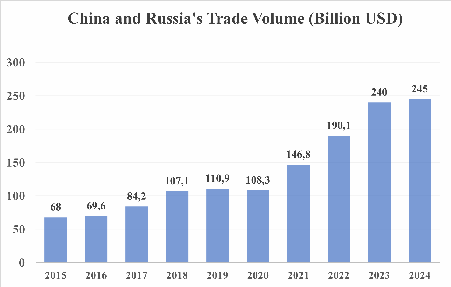
Due to the West's increasing sanctions against Russia, Russia's isolation from European markets in the energy sector has taken its energy trade relations with China to a whole new level. As of 2022, China has become Russia’s largest oil and natural gas buyer, with trade between the two countries exceeding $190 billion (von Essen, 2023). This growing trade volume reached $240 billion in 2023 and $245 billion in 2024. During this process, China has secured long-term energy purchases at more favourable prices in its agreements with Russia (it could also be said that China has taken advantage of Russia’s current situation).
Source: Trading Economies, China Indicators and Data Set
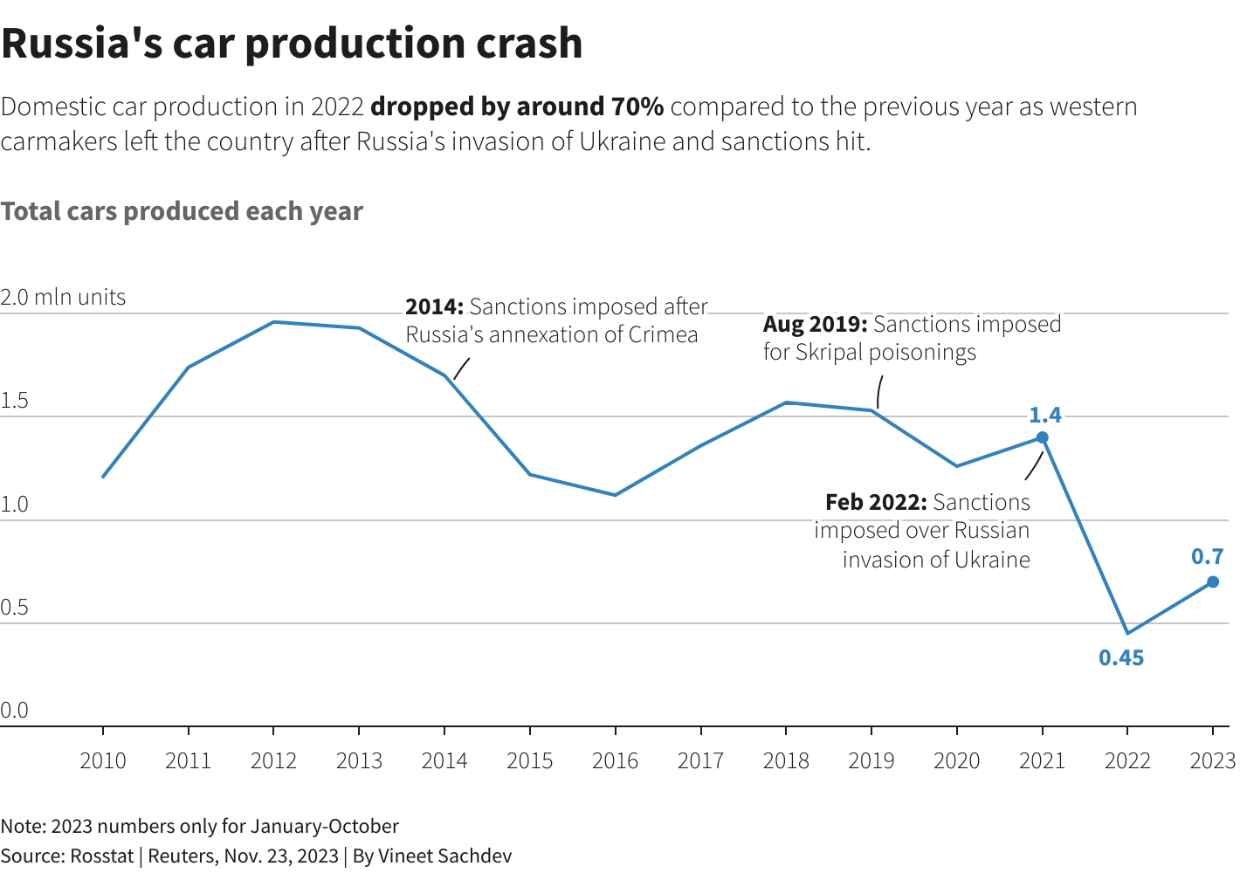
To avoid potential sanctions within the Western-dominated financial system, China has established a Ruble and Yuan-based payment mechanism, excluding SWIFT. This mechanism has enabled a significant percentage of trade between the two countries to avoid the West’s sphere of influence. The Yuan’s use in trade between China and Russia reached 40%, and 54% on the Moscow Exchange (MOEX) by 2023. The withdrawal of Western and Western-origin investments from the Russian market due to economic sanctions was quickly offset by the Chinese government and Chinese investors. Despite this, the cautious approach of China’s largest banks in investing in Russia demonstrates the Beijing government’s strong desire to maintain its ties to the Western financial system. While China has preferred to maintain its strategic partnership with Russia and to exploit this crisis by acting as a “savior” to Russia, it is now so integrated into the global financial system that it cannot afford to be completely isolated from this system or face global economic sanctions from it. This stance by China, coupled with the fact that Russia has avoided a major crisis thanks to China, has opened a strategic exit for Russia and created an increasingly deepening economic influence within the Russian economy. Chinese companies have strengthened their presence in the construction, electronics, banking, and automobile sectors, in addition to the energy sector, and have increased their economic influence in Russia in many critical areas. More specifically, for example, after Western companies left Russia, the market share of Chinese automobile brands in Russia exceeded 40% in 2023 (reaching 49% by the end of 2023) (Xinhua, 2024). Furthermore, the approximately 70% decrease in the number of automobiles produced in Russia following Western sanctions has paved the way for Chinese-made automobiles to rapidly meet demand and gain significant market share.
- Rational Approach in the Military Field
The military relationship between China and Russia has been shaped by defense industry, technology transfer, and joint military exercises. However, since the beginning of the Russo-Ukrainian war, cooperation between the two countries has remained limited to symbolic levels. China has not provided direct military support to Russia, but has provided indirect support through military products such as “commercial” drones, dual-use components, optical systems, and electronic circuits (Swanstörm & Scobell 2024; CEPA, 2025). In April 2025, Zelensky claimed that 155 Chinese soldiers were fighting for Russia on Ukrainian soil, but Chinese Foreign Ministry Spokesperson Lin Jian denied such claims and stated that China supports a peaceful resolution of this “crisis.” (BBC News, 2025).

Note: A photo of one of the two Chinese citizens caught fighting, which Zelensky shared in his claim.
Since China’s indirect support mentioned above was carried out through “material transfers,” which remain in a gray area in international law, China did not appear to provide direct support and was not affected by potential sanctions imposed by the West.
- Perception Management Applied by China
China’s rhetoric targeting domestic and international public opinion is largely carried out through media channels financed and controlled by the Chinese state. China-based media outlets such as Global Times blame NATO’s expansionist policies for the outbreak of the Russo-Ukrainian War, while using the Moscow government’s official terminology, “special military operation,” to describe the war (Tran et al., 2025). While China attempts to portray itself as supposedly neutral and a “peace ambassador” based on this perception management, it has been criticized and deemed untrustworthy by Western public opinion and “more democratic states.” (Julienne, 2025).
- The Balance Policy Trying to Be Established with the West
China’s fundamental policy, which has persisted for many years and continued throughout the war, has been to maintain a certain level of relations with Russia (and even increase rapprochement) while maintaining trade, technology, and investment ties with Western powers. Compared to the pre-war period in 2022 and 2023, trade volume between China and Europe remained unchanged, and Chinese companies acted with extreme caution to avoid direct exposure to sanctions from Western powers. (Intereconomics, 2025 & Eurostat, 2025).

Note: European Union’s (EU) trade with China, between 2014-2024.
For China, Russia’s war with Ukraine is viewed not as a crisis for its ally, but rather as an opportunity to expand its own maneuverability by making eastern moves in reshaping the international order (Swanström & Scobell, 2024). Furthermore, this war can be considered an experiment testing the scope and limits of China-Russia relations. While China was not directly involved in the war, it provided Russia with the greatest support in prolonging the war by supporting it in many areas. In this context, although the relationship between the two countries has become increasingly critical for both sides, it has also demonstrated to the world that this alliance is an asymmetrical relationship based on interests and increasingly favouring China.
IV. Strategic Calculations in China-Russia Relations
- Russia’s Growing Economic and Diplomatic Dependence on China
The most striking aspect of China-Russia relations in the post-2022 Russo-Ukrainian War era is the increasing structural asymmetry between the two states. Due to unprecedented sanctions imposed on Russia by Western countries, Moscow’s economic room for maneuver has significantly narrowed, and it has become increasingly dependent on China in many strategic areas such as energy, technology, banking, and logistics (von Essen, 2023). During this period, China has aggressively entered the Russian market, filling the gap left by Western companies and becoming the country’s most powerful player in automotive, electronics, and infrastructure investments. In 2023, China accounted for approximately 50% of Russia’s total imports and over 40% of its energy exports (The Observatory of Economic Complexity, 2025). These data demonstrate not only economic cooperation but also the significant control China has gained over Russia’s strategic sectors. China’s economic power also increases political pressure on the Moscow government and limits Russia’s flexibility in foreign policy (Bogusz & Rodkiewicz, 2025). In this context, Russia’s tendency to cooperate with China, even in the face of conflicts of interest in Central Asia and the Arctic, is a manifestation of the political dimension of Russia’s structural dependence on China (Julienne, 2025).
- Why Does China Remain Cautious?
As emphasized throughout this article, while China has increased its strategic engagement with Russia, it remains cautious and maintains its distance. There are several reasons behind this cautious behavior:
First, China’s dependence on international value chains and the Western-based economic system is so profound that it cannot afford to fully confront Western countries. By 2023, 45% of China's exports will go to the EU and the US. This prevents China from adopting a hard line that would undermine its economic relations with the US and the EU, regardless of the circumstances (Swanstörm & Scobell, 2024).
Second, although China views Russia as a strategic partner, it does not ideologically wish to remain in the same geopolitical camp with Russia indefinitely. China, which advocates and seeks to implement multipolar discourse and policies in global politics, seeks to act as a balancing force in the world order without possessing the power to fully impose its leadership claim. Therefore, its friendship with Russia is pragmatic and directly related to its own interests (Julienne,2025).
Third, the Taiwan issue is one of China’s top foreign policy priorities. Beijing prefers to pursue its claims over Taiwan without engaging in direct conflict with the West, even defining the issue as its own internal affair. Therefore, it avoids taking steps that would escalate military tensions and instead prioritizes tools such as diplomacy and economic pressure. It uses its stance on the Ukraine issue as a testing ground for its Taiwan policy, gauging international reactions and developing strategies for how to act in similar situations.
- Is the Balance of Power Shifting in Central Asia?
Central Asia, historically seen as Russia’s “backyard,” is now the strategic hub of China’s mega-project, the Belt and Road Initiative. China is increasingly assuming a dominant role in the region, particularly through its investments in infrastructure, oil pipelines, and trade corridors in countries such as Kazakhstan, Tajikistan, and Uzbekistan (Özdemir, 2024). Russia, due to its focus on the war in Ukraine, lost its former influence in Central Asia, and while its “ally” grappled with challenges in many areas, China filled this void in Central Asia (Springer, Zhang, & Ivanov, 2022). China’s investments in the region and strategic partnerships with Central Asian countries are seen as a response to Russia’s “backyard” strategy and rhetoric, supporting the thesis that “regional leadership” has completely shifted to China. However, China’s rise in the region cannot be said to have proceeded entirely smoothly. The anti-Chinese social reactions of the Central Asian people and Russia’s efforts to maintain cultural and linguistic ties (even if symbolic) stemming from its long-standing dominance in the region indicate that the rivalry in this region may shift to a more tense level in the long term in China-Russia relations.
- The “Junior Partner” Debate and the Asymmetric Strategic Alliance
In recent years, the term “junior partner” has become frequently used in academic literature regarding the relationship between China and Russia. The term “junior partner” describes Russia’s secondary (inferior) role vis-à-vis China in economic, technological, and diplomatic terms (Peterson, Smith & Lee, 2023). While the parties officially refer to an “equal strategic partnership,” China is clearly the stronger and more dominant partner. China’s growing influence over Russia, Russia’s extreme dependence on China in critical sectors, and China’s growing hegemonic role in international institutions such as the BRICS and the SCO all demonstrate that China is the “senior partner” in the relationship between the two countries, and that Russia is on the verge of losing out entirely in the competition with China.
V. Future Prospects and Scenarios in China-Russia Relations
1. Where Are China-Russia Relations Headed?
In the aftermath of the 2022 Russo-Ukrainian War, the strategic cooperation between China and Russia has become more pronounced but also more fragile. China has now almost irreversibly deepened its economic ties with Russia, which is subject to Western sanctions, and has achieved significant gains during this period. With its increasing trade volume, China has become Russia’s economic lifeline (Council on Foreign Relations [CFR], 2024). Of course, China’s support for Russia is not and cannot be unlimited, but Beijing is not jeopardizing its trade and diplomatic relations with the West by not sending direct military aid and maintains a cautious diplomatic approach. The relationship between China and Russia will be shaped in the coming years by the actions of the US and the West, China’s global leadership agenda, and Russia’s strategies for overcoming its current crises. Three main scenarios can be considered for the future of this relationship: the formation of an authoritarian bloc, a limited partnership of interests, and China's instrumentalization of Russia (Peterson ve diğerleri, 2023; Swanström & Scobell, 2024).
- Scenario 1: Formation of an Authoritarian Bloc
In this first scenario, China and Russia are assumed to have a permanent and almost insoluble rupture in their relations with the West, with issues such as the Taiwan issue or NATO’s eastward expansion creating a security-focused axis. In this scenario, a tendency toward bloc formation is assumed, and the institutionalization of a joint military alliance and the alignment of foreign policy actions may become central (CEPA, 2025). In particular, the agreements signed between China and Moscow in 2025 have deepened cooperation between the two countries in the areas of defense, technology, energy, finance, and international law. However, the CEPA report clearly emphasizes that while current cooperation is feasible, it has its limits. Joint military exercises remain merely symbolic. Even as Russia’s dependence on China grows, China strives to maintain flexibility in its relations with the West.
Moreover, China’s claims of global leadership and its strategic plans in this direction, as well as its dependence on the system due to global economic chains and trade relations with Western states, weaken the possibility of this bloc scenario coming true.
- Scenario 2: Limited Partnership of Interest
In a scenario where the world order does not undergo a radical change and transformation and the status quo is largely maintained, cooperation between China and Russia cannot transform into a full-fledged military alliance, even if it continues to gradually develop in strategic areas such as energy, defense, technology and infrastructure investments.
The existing strategic partnership between China and Russia has made both countries particularly vulnerable to potential economic sanctions from the West, potential disruptions in supply chains, and NATO’s eastward expansion. The rapprochement between the two sides can be characterized as a form of “limited strategic coordination” because, while Beijing and Moscow have increased their coordination through joint military exercises, alternative payment systems, and multilateral institutions such as the BRICS and SCO, they are unable to form a comprehensive military or ideological alliance (Julienne, 2025; Intereconomics, 2025). This second scenario appears more likely given that both countries embrace multipolarity as their foreign policy interests and cannot conceive of their domestic political legitimacy independently of international stability. While China continues to develop and sustain its economic relationship with Western markets as a central player in global supply chains, Russia is striving to diversify its export revenues from China in the fields of energy and technology while simultaneously striving to break free from excessive dependence. In this context, Russia recognizes China’s specific weight in the economic sphere and pursues a partnership that will advance in line with its own interests, while China sees Russia as a strategic partner that increases its bargaining power against the West.
- Scenario 3: China's Instrumentalization of Russia
In the third scenario, China no longer views its relations with Russia as a partnership of equals but rather as an “asymmetric instrumentalization” model. In this scenario, China views Russia as a strategic buffer against the West and a reliable source of energy and raw materials. However, when its geopolitical and/or economic priorities conflict, it is reluctant and hesitant to support Russia (Bogusz & Rodkiewicz, 2025). Russia's exclusion from the Western-centric global financial system and the heavy sanctions imposed after the Russo-Ukrainian War have created an opportunity for China to establish a massive economic sphere of influence. The rapid entry of Chinese banks into the Russian financial system, vacated by the West, the substitution of SWIFT with alternatives like UnionPay, and the proliferation of Yuan-based financial transactions have further deepened this dependency. This process also means a “loss of strategic autonomy” for Russia (von Essen, 2023). China's economic dominance in the Russian market, its export superiority over Russia in all sectors except energy, its control of digital infrastructure, and its growing influence in international organizations have made China a distinct power center vis-à-vis Russia. Furthermore, the Beijing government's desire to rise independently, without forming alliances with the West, and the strategies it implements to achieve this, have forced it to keep relations with Russia in a secondary position. This situation is pushing Russia into an increasingly ineffective position vis-à-vis China, while offering China the opportunity to expand its strategic influence without directly confronting international risks. Considering current trends and the power asymmetry between the two countries, this scenario can be considered a highly probable development in the medium term.
1.4 What Could Be the Consequences for the US and Europe?
The future course of relations between China and Russia will be decisive not only for the geopolitics of Asia-Pacific and Eurasia but also for the strategic agenda of the entire Western world and the new world order.
In the first scenario where I talked about the formation of an “authoritarian bloc” where the two countries develop institutionalized military, economic, and diplomatic cooperation (becoming truly anti-Western allies), this could lead to NATO adopting a broader deterrence approach on its eastern border. This could include maintaining a more permanent military presence in border states like the Baltics, Poland, and Romania, significant increases in direct defense spending by European states (such as the commitment made at the 2025 NATO Hague Summit for NATO Allies to increase defense spending to 5% of GDP by 2035 [NATO, 2025]), and a tendency for the US to maintain a permanent military presence in Europe. However, this scenario increases the risk of international instability in terms of the global nuclear balance and could fuel new Cold War-style bloc trends.
In the second scenario, a “limited partnership of interests,” China and Russia maintain their strategic autonomy and coordinate only in specific areas, creating a relatively manageable balance for the West. If this occurs, the US and European Union’s strategy of containing Russia with sanctions may be partially effective, while maintaining complete economic ties with China could be seen as a diplomatic success and create a more sustainable environment. Europe’s attempts to diversify its energy supply and manage its commercial dependence on China would become crucial both in terms of further isolating Russia and exerting economic pressure on China.
In the third, and in my opinion the more likely scenario of “China's Instrumentalization of Russia,” China’s growing economic and technological dominance over Russia could be seen as both a threat and an opportunity for Western states. China’s instrumentalization of Russia, using it entirely as geopolitical leverage, could lead to Russia’s increasing marginalization within the international system and its search for new diplomatic engagements with the West. For example, Putin’s agreement to meet with Trump in Alaska to end the Russo-Ukrainian War and secure a settlement (BBC News, 2025). Conversely, US sanctions and supply chain policies against China could force it to make concessions, limiting its integration with Russia and thus weakening this axis. This could create “strategic gaps” in priority areas such as defense, energy, technology, and even the increasingly important artificial intelligence.
VI. Conclusion
The purpose of this article is to examine the development and transformation of China-Russia relations in the economic, diplomatic, geopolitical, and historical contexts of the post-Soviet era, focusing particularly on the structural impact of the 2022 Russo- Ukrainian War on these relations. From an outside perspective, it is clear that this relationship is neither a purely ‘absolute alliance’ nor a ‘partnership of equals,’ but rather an asymmetrical relationship that grows and expands in favor of China.
The most important factor in this development is China’s becoming a more complex and pragmatic foreign policy actor. China not only avoids direct conflict with the West but also aims to leverage Russia in its current difficult situation to achieve its own strategic interests. This has led China to ‘develop relationships’ rather than ‘form alliances’ in the classical sense, allowing the country to address its geopolitical concerns with extreme pragmatic and flexibility. China’s relationship with Russia is characterized by a flexibility based on interests rather than shared values.
For Russia, this period has marked a significant decline in its influence in the global order and a constraint on its foreign policy independence. The increasingly severe sanctions, economic embargoes, and institutional exclusions it has faced in every field, which began after 2022, have made Russia even more dependent on China. This, in turn, has placed China in a more dominant position over Russia economically, technologically, and to some extent, diplomatically.
This asymmetry between the two countries manifests itself not only in the balance of power but also in representation. While China assumed the role of a neutral, peaceful mediator in the post-war period, Russia has been positioned as a ‘disruptive’ actor in the international order. As the NATO Secretary General stated in his speech at Chatham House on June 9, 2025 (Chatham House, 2025), Russia remains the number one threat to the West, even ahead of China, and this situation is expected to persist in the near future.
Ultimately, China-Russia relations will remain characterized by mutual suspicion, as they have long been, but China’s rise and Russia's decline to secondary power, or “junior partner,” will make the relationship increasingly asymmetrical. While the strategic partnership may persist in some form, the relationship between the two countries will remain an ad hoc, expedient one; susceptible to rapid reshaping, especially in times of crisis.
A clear implication in this regard is that the relationship between China and Russia offers a new paradigm of cooperation, one focused on fluidity and crisis management, beyond traditional alliance theories. This model of relationship has the potential to lead other “authoritarian-non-democratic” regimes to pursue the same pragmatic balancing policies in the future, but the sustainability of this model between these two countries depends not only on a shared interest but also on China’s steps toward leadership in its own vision of a new world order. As long as China positions Russia as a strategic tool rather than an ‘equal partner’ in this partnership, the boundaries of the relationship will be reshaped according to China’s global agenda rather than Russia’s consent.
In conclusion, it should be emphasized that while the China-Russia partnership emerges as an alternative to countering the West’s hegemony within a multipolar world system, it is also shaped by the increasing power asymmetries within the relationship. In this context, this article aims to contribute to the literature with a multidimensional assessment by examining the structural crises and tensions within the relationship, the differences and interdependencies in diplomatic approaches, and, ultimately, the geopolitical dynamics.
References:
BBC News. (2025, August 9). Trump and Putin to meet in Alaska for Ukraine talks next week. BBC News. https://www.bbc.com/news/articles/c1dxed639n7o
BBC News. (2025, April 10). Zelensky claims 155 Chinese fighting for Russia in Ukraine. BBC News. https://www.bbc.com/news/articles/c1wdd228953o
Bogusz, M., & Rodkiewicz, W. (2025). Three years of war in Ukraine: The Chinese–Russian alliance passes the test (OSW Commentary No. 639).
Chatham House. (2025, June 9). NATO Secretary General Mark Rutte – Building a better NATO [Video]. YouTube. https://www.youtube.com/watch?v=q8cL0VQeOOk&t=1619s
Council on Foreign Relations. (2024, February 6). Where is the China-Russia partnership headed? Seven charts and maps. https://www.cfr.org/article/where-china-russia-partnership-headed-seven-charts-and-maps
CEPA. (2025). Russia and China military cooperation: Just short of an alliance. Center for European Policy Analysis.
Eurostat. (2025). China-EU – international trade in goods statistics [PDF]. Statistics Explained. https://ec.europa.eu/eurostat/statistics-explained/index.php/International_trade_in_goods_-_a_statistical_picture
Intereconomics. (2025). China–Russia cooperation: Economic linkages and sanctions evasion. Intereconomics, 60(2), 135–140. https://doi.org/10.2478/ie-2025-0025
Ivanova, M. (2024). Sino-Russian rapprochement after Russia’s invasion of Ukraine. Journal of World Affairs, 22(1), 45–67. https://doi.org/10.1080/09512748.2024.2368227
Julienne, M. (2025). The China–Russia partnership and the Ukraine War: Aligned but not allied (Reconnect China Policy Brief No. 20).
Lederer, E. M., & Peltz, J. (2024, September 22). UN nations endorse a ‘Pact for the Future,’ and the body’s leader says it must be more than talk. AP News. Retrieved July 15, 2025, from https://www.apnews.com/article/un-pact-future-russia-challenges-climate-ai-accf4523e01c6604707189333de289ce
NATO. (2025, June 26). Future-proofing NATO’s industrial capacity: How decisions at the NATO Summit in The Hague will strengthen the Allied defence industry. NATO Review. https://www.nato.int/docu/review/articles/2025/06/26/future-proofing-natos-industrial-capacity-how-decisions-at-the-nato-summit-in-the-hague-will-strengthen-the-allied-defence-industry/index.html
Peterson, J., Smith, A., & Lee, C. (2023). Sino–Russian relations in the post-Soviet era. International Affairs, 99(4), 1015–1034. https://doi.org/10.1080/00131857.2023.2179485
Saxena, R. (2024). Relations between China and Russia following the outbreak of the Ukraine War in 2022. Journal of Iran and Central Eurasia Studies, 7(2), 147–162. https://doi.org/10.22059/jices.2025.390410.108
Springer, M., Zhang, Y., & Ivanov, P. (2022). Thirty years of China–Russia strategic relations. China International Strategy Review, 4, 101–120. https://doi.org/10.1007/s42533-022-00101-6
Stolyarov, G., & Marrow, A. (2023, November 24). Chinese car sales boom in Russia levels off amid shaky local recovery. Reuters. https://www.reuters.com/business/autos-transportation/chinese-car-sales-boom-russia-levels-off-amid-shaky-local-recovery-2023-11-24/
Swanström, N., & Scobell, A. (2024). Ukraine: The inflection point in the China–Russia axis. United States Institute of Peace.
Tran, T., Sautede, E., et al. (2025). China and the Ukraine War: Global Times' strategic narratives. Global Media and Communication, 21(1), 1–23. https://doi.org/10.1177/17427665251328117
von Essen, H. (2023). Russia–China economic relations since the full-scale invasion of Ukraine. SCEEUS Report No. 2.
Xinhua. (2024, January 15). Chinese car brands make up nearly half of Russia's car market. XinhuaNet. https://english.news.cn/europe/20240115/ed7189eab6744e48972fb1bca4a3f2fa/c.html
Zenel, G., & Modlin, B. (2022). Sino–Russian relations and the war in Ukraine. Parameters, 52(3), 35–60. https://doi.org/10.55540/0031-1723.3165